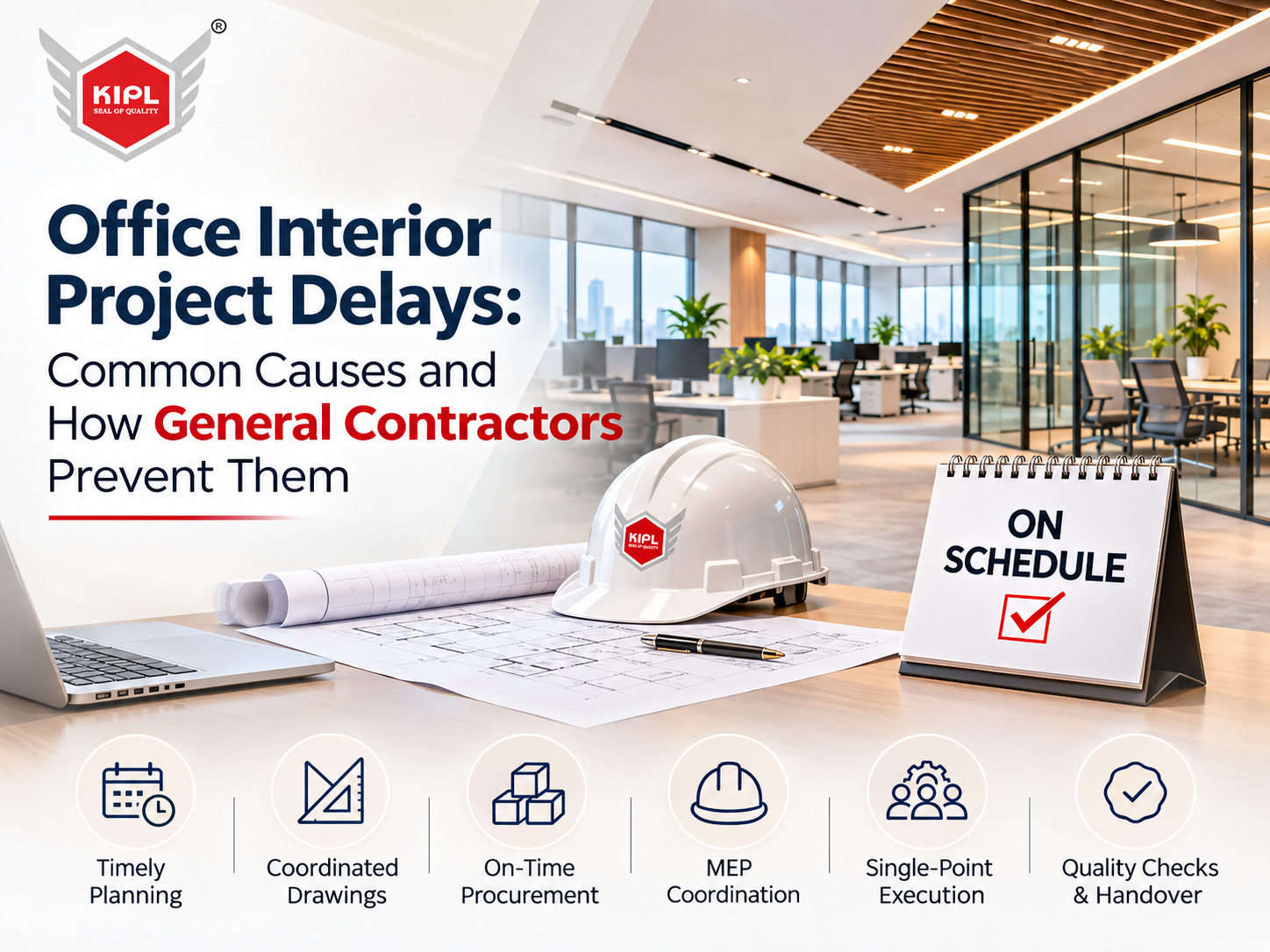
Office Interior Project Delays: Common Causes and How General Contractors Prevent Them

Office Interior Project Delays: Common Causes and How General Contractors Prevent Them

Office Interior Project Delays : Common Causes and How General Contractors Prevent Them

Office interior projects are often tied to fixed business dates. A company may have a lease starting, employees waiting to move, technology teams preparing systems, and management expecting the new workplace to become operational on time.

When an office fit-out is delayed, the impact can go beyond construction. Businesses may face additional rent, extended temporary-office costs, delayed employee relocation, repeated vendor visits and disruption to planned operations.

For businesses planning a commercial office fit-out in Mumbai, understanding what causes delays is important. Most project delays do not begin with the final finishing work. They often start much earlier through incomplete requirements, late approvals, poor coordination or delayed procurement. Current Mumbai fit-out guidance similarly identifies weak briefs, design changes, long-lead procurement, approval cycles and MEP clashes as major causes of schedule slippage. A professional general contractor in Mumbai helps control these risks by coordinating design information, contractors, procurement, site activities and approvals through one structured project programme.

Incomplete Project Requirements

One of the earliest causes of delay is starting a project before the client’s requirements are properly defined. Workstation numbers, meeting-room requirements, cabins, storage, technology needs and future expansion should ideally be agreed before detailed execution begins. If these requirements continue changing after site work starts, even a small layout revision can affect partitions, electrical points, HVAC, ceilings, furniture and data infrastructure. A professional general contractor works with the client and design team to clarify important requirements before affected work packages begin. This gives the execution team a more stable basis for scheduling and procurement.

Starting Execution Before Drawings Are Ready

Construction should not move faster than the information required to execute it correctly. Incomplete working drawings can result in contractors repeatedly seeking clarifications on site. In more serious cases, completed work may need to be removed and rebuilt after the final design is issued. Coordinated drawings for architectural work, electrical systems, HVAC, ceilings, fire services, data and furniture should therefore be prepared and reviewed before relevant execution starts. Recent commercial fit-out guidance consistently identifies incomplete drawings and late design changes as major sources of rework and delays. A general contractor helps control drawing revisions and ensures site teams work from the latest approved information.

Poor MEP and Interior Coordination

Modern office interiors contain several technical services within limited space. The same ceiling area may contain electrical cables, lighting, HVAC ducts, diffusers, sprinklers, smoke detectors and data infrastructure. If each contractor works independently, clashes can occur during installation. A duct may interfere with a light fitting, a sprinkler may conflict with a ceiling feature, or an electrical point may end up behind fixed furniture. Correcting these problems after installation consumes both time and money. A professional commercial interior contractor in Mumbai coordinates architectural and MEP services before installation and conducts site checks before concealed work is closed.

Delayed Material Selection and Procurement

Interior projects depend on materials arriving at the right stage of the project. Flooring, lighting, glass, laminates, hardware, furniture, acoustic materials and HVAC equipment can all have different lead times. When material selections remain pending after execution starts, procurement also gets delayed. Long-lead products can then become part of the project’s critical path. Current Indian fit-out guidance identifies late material decisions and long-lead procurement as recurring causes of missed handover dates. A general contractor helps by preparing procurement schedules, identifying long-lead materials early and tracking deliveries against the overall project programme.

Building Management and Approval Delays

Commercial buildings in Mumbai often have specific fit-out procedures. Building management may need to review drawings relating to HVAC, fire systems, electrical work, contractor access or other modifications. Sites may also have restricted work timings, material movement procedures and service-lift schedules. If these requirements are discovered only after construction begins, the project schedule can be affected. Experienced office fit-out contractors in Mumbai review building guidelines at an early stage and coordinate submissions alongside design development. This is especially important in Grade-A commercial towers and high-rise properties where fit-out activities may need to follow strict property-management procedures.

Multiple Contractors Working Without One Schedule

A commercial interior project may involve civil contractors, electricians, HVAC technicians, ceiling installers, flooring teams, carpenters, furniture suppliers and technology vendors. The problem is not the number of specialists. The problem occurs when everyone works according to a separate schedule. One team’s delay can prevent another contractor from starting. A general contractor creates one master project programme that identifies activity dependencies and defines when different teams need to enter and leave the site. This creates better sequencing and reduces idle time between activities.

Slow Client Approvals

Contractors are not always the reason projects get delayed. Pending decisions regarding layouts, colours, furniture, samples, finishes or additional requirements can stop dependent work. For example, flooring cannot be purchased until the material is approved. Custom furniture cannot begin manufacturing until dimensions and finishes are confirmed. A professional project-management process therefore includes an approval tracker with clear decision dates. Keeping approvals documented also prevents confusion about which option was finally accepted.

Scope Changes During Execution

Changes are sometimes unavoidable. A business may decide to increase seating, create an additional cabin or upgrade meeting-room technology after construction has already started. However, every change has a potential impact on the project. The general contractor should assess how the revision affects drawings, materials, cost and timeline before executing it. A clear change-control process prevents informal site instructions from creating hidden schedule problems later.

Unclear BOQ and Project Scope

A weak or incomplete Bill of Quantities can create disagreements during execution. If certain items are not clearly included, the client and contractor may need to discuss additional costs or responsibilities after work has already started. This can delay decision-making and procurement. A detailed BOQ should clearly describe project quantities, material specifications, inclusions and exclusions before execution. Recent fit-out timeline guidance also identifies incomplete BOQs and tender information as a common source of scope clarification and programme delay.

Insufficient Time for Testing and Snagging

An office is not ready simply because the furniture has been installed. Electrical systems, lighting, HVAC, plumbing, data infrastructure and other services need appropriate testing. Finishes also need to be inspected and minor defects corrected. When testing and snagging are not included in the original schedule, the project can appear complete while still requiring several days of corrective work. Indian office fit-out guidance typically treats testing, snagging and handover as a distinct final phase rather than an optional extra. General contractors help by planning this stage before the client’s actual move-in date.

Why Early Planning Matters More Than Fast Execution

Businesses sometimes try to recover time by pushing contractors to work faster after delays have already occurred. However, the most effective way to shorten an office fit-out is usually to make important decisions earlier. Requirements should be frozen early, drawings coordinated before installation, long-lead materials ordered on time and building approvals started before they become urgent. Recent project guidance consistently shows that many delays originate before site execution rather than during the final construction stage. Strong pre-construction planning gives the site team a better chance of completing the project according to schedule.

General Contracting with Kshatriya Infrastructure

Kshatriya Infrastructure Pvt Ltd understand that successful commercial interior execution requires careful coordination between design, procurement, contractors, technical services and project timelines. Our general contracting services in Mumbai focus on structured execution across civil works, commercial interior fit-outs, MEP coordination, project management and final handover. By bringing multiple project activities under one coordinated execution process, we help businesses reduce avoidable rework, improve project visibility and manage their workplace fit-out more efficiently.

For companies planning a new office, commercial interior fit-out or office renovation in Mumbai, selecting an experienced general contractor can play an important role in keeping the project organised from planning through final completion.

How General Contractors Simplify Commercial Interior Fit-Out Projects

How General Contractors Simplify Commercial Interior Fit-Out Projects in Mumbai by KIPL
How General Contractors Simplify Commercial Interior Fit-Out Projects in Mumbai

How General Contractors Simplify Commercial Interior Fit-Out Projects in Mumbai

A commercial interior fit-out involves much more than furniture, flooring and finishes. It requires coordination between civil works, electrical systems, HVAC, plumbing, fire safety, ceilings, partitions, joinery, furniture and several specialist teams.

When these activities are handled separately, businesses can face delays, communication gaps and repeated coordination issues.

This is where a professional commercial interior contractor in Mumbai becomes important. A general contractor brings different project activities under one coordinated execution structure, helping businesses manage commercial fit-out projects with greater clarity and control.

One Point of Coordination

One of the biggest advantages of appointing a general contractor is having a single point of coordination.
Instead of communicating separately with civil contractors, electricians, HVAC vendors, carpenters and flooring teams, the client works through one project lead. This helps simplify communication and creates clearer responsibility across the project. Current Mumbai fit-out providers increasingly position single-point accountability as a key advantage of integrated commercial interior execution.

Better Coordination Between Civil and MEP Works

Civil and MEP services are closely connected in any office fit-out.

Partitions affect electrical points. Ceiling layouts affect lighting, HVAC diffusers and fire systems. Furniture placement influences power and data requirements. If these services are planned independently, site clashes can occur and completed work may need to be modified. A professional general contractor in Mumbai coordinates these activities before and during execution, helping reduce rework and improve site efficiency.

Better Project Scheduling

Commercial office projects are often linked to fixed lease dates, employee relocation plans or business-opening schedules.

A delay in one activity can affect several others. For example, delayed electrical work may affect ceiling closure, which can delay lighting, painting and furniture installation. A professional office fit-out contractor in Mumbai manages these dependencies through an integrated project schedule. This allows different teams to work in the correct sequence and helps identify potential delays earlier.

Improved Quality Control

Quality control becomes easier when all major activities are coordinated through one project management structure.

The general contractor can monitor civil work, partitions, flooring, ceiling finishes, electrical installations, furniture and other details against approved drawings and specifications. Regular site checks also help identify workmanship issues before they affect later stages. This creates a more consistent standard across the complete commercial interior fit-out project.

Simplified Material and Vendor Management

Commercial interiors require a large number of materials and specialist products.
Flooring, lighting, glass, hardware, electrical components, ceiling systems, furniture materials and finishes all need to reach the site according to the project program. If procurement is not planned correctly, one delayed material can affect several activities. A general contractor coordinates material schedules and vendors so that procurement supports the overall execution plan rather than becoming a separate problem for the client.

Better Management of Site Changes

Changes are common during office interior projects.
A meeting room may need to be resized, workstation numbers may change or additional electrical points may be required.
The important factor is how these changes are managed. A professional general contractor evaluates the impact of a change on cost, drawings, materials and project timelines before execution. This reduces informal site changes and helps maintain better control over the project.

Smoother Coordination with Building Management

Commercial buildings in Mumbai may have specific requirements related to contractor access, service lifts, work timings, debris removal, fire systems and landlord approvals.

These requirements can directly influence the fit-out schedule. Experienced commercial interior contractors in Mumbai understand that building-management coordination is part of the execution process, not a separate activity. Current Mumbai fit-out firms also highlight landlord rules, approval processes and base-build coordination as important factors in commercial projects.

From Bare Shell to Final Handover

A general contractor can manage the complete execution journey from an empty or bare-shell office to a finished workplace.

This may include civil work, MEP services, partitions, ceilings, flooring, carpentry, furniture, painting, final finishing and testing. An integrated approach creates better continuity between different stages and reduces the need for the client to manage several contractors independently. This is one reason businesses often prefer a general contracting company in Mumbai for larger office fit-out projects.

Why General Contracting Works for Mumbai Businesses

Mumbai commercial projects often operate under tight timelines and complex building conditions.
Space constraints, access restrictions, high commercial rents and strict handover dates make project coordination especially important. A professional general contractor helps businesses manage these challenges through one organised project structure. For companies setting up new offices, renovating existing workplaces or moving into bare-shell commercial properties, this can reduce coordination complexity and improve project visibility.

General Contracting with Kshatriya Infrastructure

Kshatriya Infrastructure Pvt Ltd provide professional general contracting services in Mumbai for commercial office interior projects. Our approach focuses on coordinated execution across civil works, MEP services, interior fit-outs, project management and final handover. By bringing multiple project activities under one structured execution process, we help businesses simplify coordination and create functional, professionally finished workplaces. Whether you are planning a new office, commercial interior fit-out or workplace renovation in Mumbai, working with an experienced general contractor can make the project easier to manage from site execution to final completion.

The Role of Project Execution in Successful Commercial Interior Projects in Mumbai

Role of project execution in successfull commercial interior projects in Mumbai

The Role of Project Execution in Successful Commercial Interior Projects in Mumbai

A successful commercial interior project is not completed by design alone. A good design can create a strong vision, but professional project execution turns that vision into a functional, finished, and business-ready workspace. In a fast-moving city like Mumbai, where commercial spaces are valuable and timelines are often tight, project execution plays a very important role in the success of office interiors, commercial fit-outs, turnkey interior solutions, and workspace renovation projects. Every business wants an office that looks premium, supports productivity, reflects brand identity, and is delivered on time. To achieve this result, businesses need more than creative ideas; they need proper planning, site coordination, quality supervision, vendor management, material control, and professional execution.

Commercial interior projects involve many stages. These include understanding the client’s requirement, preparing the layout, planning the services, finalizing materials, coordinating site teams, managing timelines, checking quality, resolving site challenges, and handing over the completed workspace. If even one stage is not managed properly, the entire project can face delays, cost increases, rework, and finishing issues. This is why professional project execution is the backbone of every successful commercial interior project.

At Kshatriya Infrastructure Pvt Ltd, we understand that every commercial space has a business purpose. An office is not just a place where employees sit and work. It is a space that supports communication, collaboration, productivity, client meetings, brand presentation, and daily operations. A well-executed commercial interior project helps businesses create a better working environment while reducing stress during the project journey.

Why Project Execution Matters in Commercial Interior Projects

Project execution is the process of converting design, drawings, and planning into real work at the site. It ensures that the approved concept is implemented correctly, within the planned timeline and quality standards. In commercial interiors, execution is especially important because multiple activities happen together or one after another. Flooring, ceiling, electrical work, lighting, HVAC coordination, glass partitions, furniture, painting, branding, and finishing all need proper sequencing.

Without professional execution, a commercial interior project can become confusing. Teams may work without coordination, materials may arrive late, drawings may not match site conditions, and the client may need to manage many vendors separately. This creates stress and affects the final output. Professional project execution brings structure to the entire process. It ensures that every activity is planned, every team knows its responsibility, and every stage moves toward timely handover.

Planning: The Foundation of Successful Execution

Every successful commercial interior project starts with strong planning. Before the work begins, the execution team needs to study the site, understand the client’s business needs, review the layout, check technical requirements, finalize timelines, and identify possible challenges. This planning stage helps avoid surprises during execution. For example, an office fit-out project may require proper planning for workstation placement, meeting rooms, cabins, reception area, pantry, storage, lighting, electrical points, data cabling, air-conditioning coordination, and circulation space. If these details are missed in the beginning, the project may face changes later, which can increase time and cost.

Professional project execution ensures that the planning is practical and site-friendly. A design may look good on paper, but the execution team checks whether it can be implemented properly at the site. This connection between design and execution helps avoid mistakes and improves the final quality.

Better Coordination Between Teams

A commercial interior project requires the involvement of many teams. There may be designers, project managers, site supervisors, electricians, carpenters, ceiling teams, flooring teams, painters, glass vendors, furniture suppliers, HVAC technicians, IT networking teams, and branding vendors. If all these teams are not coordinated properly, the project can easily get delayed. Project execution creates a clear system for coordination. It defines which work will happen first, which team will enter the site next, and how every activity connects with the other. For example, electrical and data cabling work should happen before ceiling closure. Flooring should be completed and protected before furniture installation. Painting and finishing should be planned after major dust work is finished. This sequence is very important for smooth execution.

A professional project execution team acts as a single point of coordination. This reduces confusion for the client and ensures that all teams work together toward the same goal.

Time Management and Timely Handover

Time is one of the most important factors in commercial interior projects. Businesses cannot afford unnecessary delays, especially when they are moving into a new office, expanding their team, or renovating an existing workspace. Every delay can affect rent, operations, employee movement, client meetings, and business planning. Professional project execution helps control timelines through proper scheduling. A clear project timeline helps the team understand daily, weekly, and milestone-based targets. The execution team monitors progress regularly and takes action if any activity is delayed. This helps keep the project on track.

In Mumbai, where commercial property costs are high, timely handover becomes even more valuable. A professional interior fit-out company in Mumbai understands the importance of completing work within the committed timeline without compromising quality.

Quality Control at Every Stage

Quality execution is not only about how the office looks after completion. It is also about how durable, practical, and functional the workspace is in daily use. A commercial office is used every day by employees, clients, visitors, and management teams. Poor execution can lead to problems such as uneven flooring, weak partitions, poor lighting, bad finishing, electrical issues, uncomfortable layouts, and frequent maintenance requirements.

Professional project execution includes quality checks at every stage. Site supervisors inspect materials, workmanship, alignment, finishing, measurements, and installation details. If any issue is found, it is corrected early before it becomes a bigger problem.

Material Management and Procurement Planning

Material management is a key part of successful commercial interior execution. Interior projects require many materials such as partitions, glass, laminates, ceiling materials, flooring, lighting, electrical items, hardware, furniture, paints, wall finishes, and branding elements. These materials must be ordered at the right time and in the right quantity. If procurement is not planned properly, the site may face delays. For example, if glass partitions are delayed, workstation installation and finishing may be affected. If lighting fixtures are not available on time, ceiling completion may get delayed. Professional project execution includes procurement planning so that materials reach the site as per the project schedule.

In Mumbai, where site storage space is often limited, material planning becomes even more important. Materials should not arrive too early and create clutter, and they should not arrive too late and stop the work. A professional team balances both requirements.

Site Supervision and Daily Monitoring

Site supervision is one of the most important parts of project execution. A site supervisor ensures that work is happening as per plan, quality is maintained, workers are following instructions, and issues are resolved quickly. Without proper supervision, even a well-planned project can face mistakes. Daily monitoring helps track progress and identify problems early. It also helps maintain discipline at the site. The execution team checks whether the right teams are available, whether materials are ready, whether safety practices are followed, and whether the project is moving according to schedule.

For office interior projects in Mumbai, site supervision is essential because many commercial buildings have strict guidelines. The site team must manage work timings, noise restrictions, material movement, and coordination with building management.

Better Space Utilization

Mumbai businesses often work with limited and expensive office space. This makes space utilization very important. A successful commercial interior project should make the best use of every square foot. Poor space planning can lead to wasted areas, crowded workstations, uncomfortable movement, and insufficient storage. Project execution plays a major role in implementing the planned layout correctly. The execution team ensures that workstation sizes, passage areas, cabin dimensions, meeting room placements, and storage units are installed accurately. Even small measurement mistakes can affect comfort and usability.

With proper execution, businesses can create workspaces that are efficient, comfortable, and suitable for growth.

Reducing Stress for Business Owners

One of the biggest benefits of professional project execution is stress reduction. Business owners, admin teams, and management teams already have many responsibilities. Managing an interior project along with regular business operations can become difficult. When a professional team handles execution, the client does not need to coordinate with every vendor separately. The execution partner manages site work, vendors, timelines, quality checks, and handover. This allows the business team to focus on their work while the project moves forward smoothly.

A stress-free project experience is especially important for office renovation and fit-out projects where daily operations may be affected.

Turnkey Interior Execution for Commercial Projects

Turnkey interior solutions are becoming popular for commercial projects because they provide one partner for the complete process. Instead of dealing with different contractors and vendors, businesses can work with one team that manages planning, fit-out execution, coordination, and handover.

Turnkey interior execution saves time and reduces confusion. It is ideal for offices, corporate spaces, commercial workspaces, and business environments where professional quality and timely delivery are important.

For businesses looking for turnkey interior solutions in Mumbai, project execution becomes the key factor that decides the success of the project. A turnkey project is only successful when the execution is organized, disciplined, and quality-focused.

Project Execution and Brand Image

A commercial office is a reflection of the brand. When clients, partners, and employees enter the workspace, they form an impression about the company. A well-executed office interior creates a sense of professionalism, trust, and confidence.

Project execution ensures that branding elements, reception design, meeting rooms, workstations, lighting, and finishes are delivered properly. A poor execution can reduce the impact of even the best design. On the other hand, quality execution can make the office look premium and professional.

For companies in Mumbai’s competitive business environment, a strong office interior can support brand positioning and client confidence.

Why Businesses in Mumbai Need Professional Project Execution

Mumbai is one of India’s most important commercial hubs. Businesses in Mumbai operate in a fast-paced environment where timelines, space efficiency, and professional image matter. Commercial interior projects in Mumbai often require careful planning because of building rules, limited work hours, traffic-related material movement challenges, and high property costs. Professional project execution helps businesses manage these local challenges. An experienced commercial interior contractor in Mumbai understands how to coordinate with vendors, manage site restrictions, plan materials, and deliver quality work within practical timelines.

Project execution is the most important link between interior design and successful project delivery. A good design becomes valuable only when it is executed properly at the site. Professional execution ensures better planning, smoother coordination, quality control, cost management, timely handover, and reduced stress for the client. In commercial interior projects, every detail matters. From layout accuracy and technical coordination to material management and finishing quality, project execution decides the final outcome. For businesses in Mumbai, where time, space, and professional image are highly important, choosing the right execution partner can make a major difference. A successful commercial interior project is not just about creating a beautiful office. It is about building a workspace that supports productivity, improves functionality, reflects brand identity, and delivers long-term value. With professional project execution, businesses can transform their commercial spaces into efficient, modern, and business-ready environments. Kshatriya Infrastructure Pvt Ltd helps businesses create commercial interiors with smart planning, quality execution, and professional project delivery.