
India’s commercial real estate landscape is undergoing a significant transformation. Rapid urbanization, expansion of corporate ecosystems, growth of startups, and the evolution of hybrid work models are reshaping how commercial spaces are designed and executed. In this dynamic environment, commercial interior contracting in India is no longer limited to basic execution—it has evolved into a strategic, technology-driven, and highly integrated service model. The future of commercial interior contracting is defined by precision, speed, sustainability, and end-to-end accountability. Over the past decade, businesses across India have started recognizing that commercial interiors directly influence productivity, brand identity, employee engagement, and operational efficiency. As a result, demand for professional commercial interior contractors, turnkey interior solutions, and integrated design-and-build services has grown rapidly. Companies today are not just looking for interior designers; they are seeking experienced commercial interior contracting companies that can deliver complete office fit-out solutions with minimal disruption and maximum quality assurance.
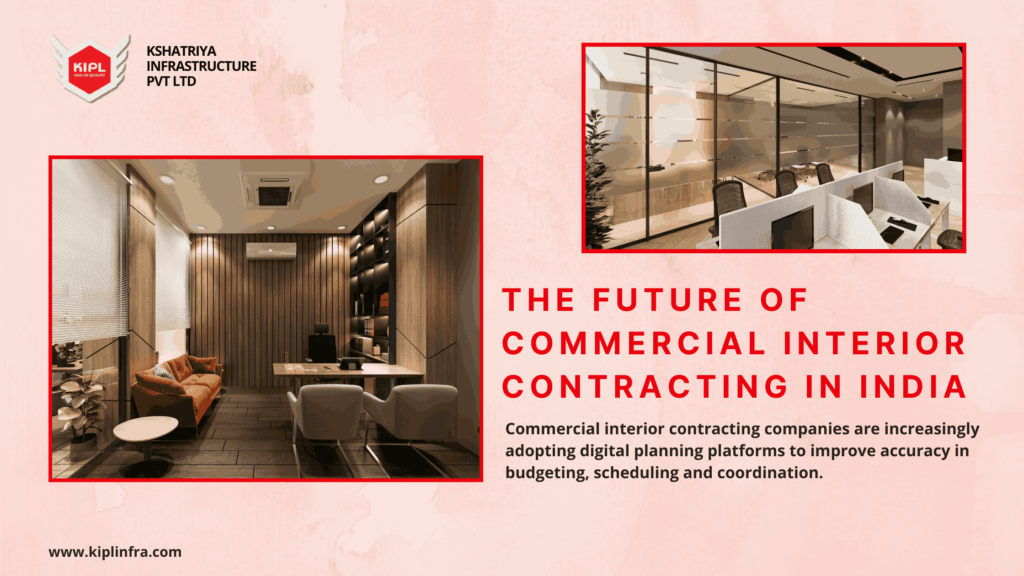
One of the most defining trends shaping the future of commercial interior contracting in India is the rise of turnkey commercial interiors. Businesses prefer a single point of responsibility where design, planning, procurement, execution, and project management are handled by one professional partner. This turnkey contracting model reduces coordination gaps, ensures cost transparency, and accelerates project timelines. In fast-growing metro cities like Mumbai, Bangalore, and Delhi NCR, where time-to-occupy directly impacts business performance, turnkey interior contractors are becoming the preferred choice. Technology integration is another major driver of change. The future of commercial interior execution in India is deeply connected to digital project management tools, Building Information Modeling (BIM), 3D visualization, and real-time site tracking systems. Commercial interior contracting companies are increasingly adopting digital planning platforms to improve accuracy in budgeting, scheduling, and coordination. This technology-driven approach minimizes rework, enhances collaboration between stakeholders, and ensures projects are delivered right the first time. Sustainability is no longer optional—it is becoming a fundamental expectation. The future of commercial interior contracting in India is strongly aligned with green building practices and eco-friendly office interiors. Organizations are actively seeking sustainable commercial interiors that incorporate energy-efficient lighting, optimized HVAC systems, recyclable materials, and low-VOC finishes. Commercial interior contractors who can integrate sustainability into project planning and execution will lead the next phase of industry growth. This shift toward environmentally responsible interior contracting also supports corporate ESG goals and long-term cost savings.
Another significant transformation is the growing importance of smart office interiors. As businesses embrace hybrid work models and digital collaboration tools, commercial interior contractors must design and execute spaces that support technology integration. From smart lighting systems and automated climate control to AV-enabled conference rooms and flexible workstation layouts, the future of commercial interior fit-outs lies in technology-enabled workplace design. Contractors who understand IT infrastructure coordination and digital workspace requirements will have a competitive advantage.
The Indian commercial market is also witnessing increased demand for flexible and scalable office interiors. Startups, coworking operators, and multinational corporations require spaces that can adapt to growth and reconfiguration. This means commercial interior contractors must plan for modular partitions, movable furniture systems, and scalable MEP infrastructure. Future-ready interior contracting involves anticipating expansion needs and designing spaces that evolve with business growth. Project management excellence will remain the backbone of future commercial interior contracting in India. As projects become larger and more complex, structured project management practices will determine execution success. Professional commercial interior contractors are investing in dedicated project managers, standardized processes, and milestone-based tracking systems. Effective project management ensures budget control, quality assurance, and regulatory compliance, which are critical in India’s fast-paced commercial environment.
Compliance and safety standards are also shaping the future of commercial interior contracting. With stricter building codes, fire safety regulations, and occupational health standards, contractors must operate with precision and accountability. The ability to manage approvals, documentation, and statutory requirements efficiently will differentiate professional interior contracting companies from unorganized service providers. Businesses increasingly prefer contractors who can guarantee compliance without delays. Cost optimization will continue to be a central focus for Indian businesses. Commercial interior contractors must balance premium design with budget efficiency. Value engineering, smart procurement strategies, and transparent BOQs are becoming standard expectations. The future of commercial interior contracting lies in delivering cost-effective office interiors without compromising durability or aesthetics. Contractors who can demonstrate long-term value rather than short-term savings will gain trust in the corporate sector. The rise of integrated contracting models is another defining trend. Instead of fragmented services involving separate designers, consultants, and vendors, businesses now prefer integrated design-and-build contractors. This integrated approach streamlines communication, reduces project risks, and enhances accountability. The future of commercial interior contracting in India will be dominated by firms that can offer end-to-end commercial interior solutions under one structured framework.
Urban commercial hubs such as Mumbai are influencing national trends. With high real estate costs and compact office spaces, contractors must specialize in space optimization and efficient layout planning. The demand for commercial interior contractors in Mumbai is driving innovation in space-saving design, ergonomic planning, and high-performance finishes. These innovations are gradually influencing practices across other Indian cities.
Workplace wellness is another critical area shaping the future of commercial interiors. Companies are investing in office environments that improve employee well-being, collaboration, and productivity. Commercial interior contractors must incorporate biophilic design elements, natural lighting strategies, acoustic planning, and ergonomic layouts into their execution processes. The ability to deliver wellness-focused commercial interiors will become a key competitive differentiator. Digital transparency will redefine client expectations. Businesses now demand regular progress updates, digital dashboards, and clear cost tracking. The future of commercial interior contracting involves greater transparency through technology-enabled reporting systems. Contractors who provide structured communication and data-driven updates will build stronger long-term relationships with clients.
As India’s economy expands, Tier-2 and Tier-3 cities are also witnessing increased commercial development. Commercial interior contracting is no longer limited to metro cities. The next growth phase will involve expanding expertise into emerging business hubs, delivering consistent quality across geographies. Standardized execution systems and scalable operational models will be critical for nationwide growth. The skillset required for commercial interior contractors is also evolving. Future-ready contractors must combine technical knowledge, design sensitivity, project management expertise, sustainability awareness, and digital proficiency. Continuous upskilling and technology adoption will define leadership in this sector. In conclusion, the future of commercial interior contracting in India is integrated, technology-driven, sustainable, and performance-oriented. Businesses are no longer satisfied with aesthetic interiors alone—they demand reliable execution, transparent budgeting, regulatory compliance, and long-term value. Turnkey commercial interior contractors who can deliver comprehensive solutions with expert project management will lead the next era of commercial development. As India continues its rapid urban and economic expansion, commercial interior contracting will play a pivotal role in shaping workspaces that drive productivity, innovation, and brand identity. The companies that embrace digital tools, sustainability practices, integrated project management, and client-centric execution will define the future of commercial interior contracting in India.
WhatsApp us
